
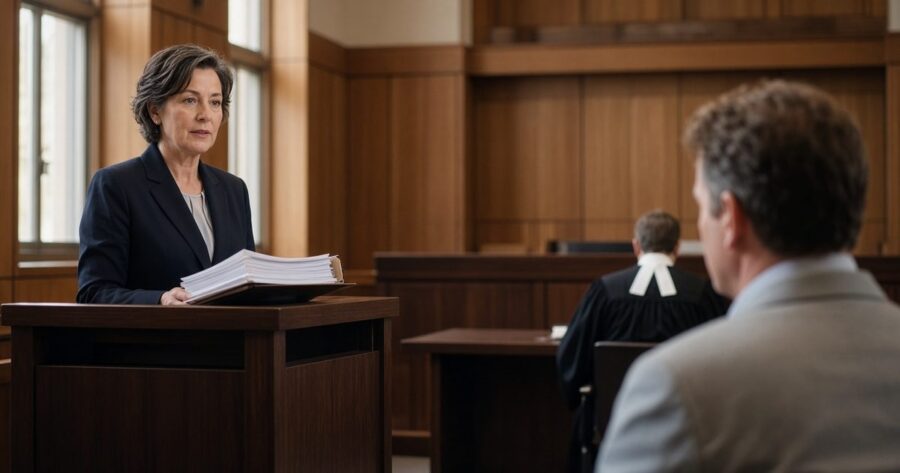
The key distinction between a lay witness and an expert witness lies in the nature of the evidence they provide and the circumstances in which they may express an opinion. A lay witness gives evidence of what they saw, heard or otherwise perceived. An expert witness may give an opinion based on specialised knowledge from their training, study or experience. The Evidence Act 1995 (Cth) and its state equivalents set out when each type of opinion evidence may be admitted.
For lawyers, knowing which type of witness you need shapes how you gather evidence, who you brief and how early you start looking for an expert.
What is a lay witness?
A lay witness, often called a fact witness, gives evidence about matters they experienced directly. That might be a bystander who saw a collision, an employee who attended a meeting, or a site manager who was present when an incident occurred.
“Fact witness” is a common term in practice. It is not a defined term in the Evidence Act. The Act focuses instead on the kind of evidence a person gives, particularly whether it is evidence of an opinion.
A lay witness can sometimes give an opinion, but only in limited circumstances, explained below.
What is an expert witness?
An expert witness is a person with specialised knowledge gained through training, study or experience, whose opinion may be admissible on matters within their area of expertise. That knowledge may come from formal qualifications, research or practical experience in a field such as medicine, engineering, accounting or construction.
Unlike a lay witness, an expert witness has an overriding duty to assist the court impartially on matters within their expertise, rather than advocating for the party engaging them.
Experts usually prepare a written report and must comply with the relevant court’s expert code of conduct. For a fuller overview of the role, see our guide on what an expert witness is, and our article on who can be an expert witness.
How the Evidence Act treats opinion evidence
Part 3.3 of the Evidence Act 1995 (Cth) deals with opinion. The Evidence Act 1995 (NSW) uses the same section numbers and substantially the same wording.
The opinion rule (s 76)
Section 76(1) states the starting point: “Evidence of an opinion is not admissible to prove the existence of a fact about the existence of which the opinion was expressed.”
In other words, opinions are excluded unless an exception applies. Sections 78 and 79 are two of those exceptions.
Lay opinions (s 78)
Section 78 says the opinion rule does not apply to an opinion expressed by a person if:
- “the opinion is based on what the person saw, heard or otherwise perceived about a matter or event”; and
- “evidence of the opinion is necessary to obtain an adequate account or understanding of the person’s perception of the matter or event.”
Both conditions must be met. The opinion has to come from the witness’s own perception, and it has to be needed to explain that perception. Where the line sits between expert opinion and everyday knowledge is discussed in our article on expert opinion or common knowledge.
Opinions based on specialised knowledge (s 79)
Section 79(1) provides that if a person has “specialised knowledge based on the person’s training, study or experience”, the opinion rule does not apply to their opinion that is “wholly or substantially based on that knowledge.”
This is the main exception for expert evidence. We will cover s 79 in more detail in a separate article.
Expert witness vs lay witness at a glance
| Lay witness | Expert witness | |
|---|---|---|
| Basis of evidence | What they saw, heard or otherwise perceived | Specialised knowledge from training, study or experience |
| Opinion evidence | Only if both s 78 conditions are met | Permitted under s 79(1) if the opinion is wholly or substantially based on that knowledge |
| Relevant section | s 78 | s 79 |
| Usual form | Affidavit, statement or oral evidence | Written expert report, often followed by oral evidence |
| Court rules | General rules for witnesses | General rules plus the court’s expert code of conduct or practice note |
Why the distinction matters when preparing a matter
The type of witness affects how you prepare evidence from the start.
For example, in a construction dispute, a site manager may give evidence about the condition of a building, the work undertaken or events they personally observed. However, determining whether the work complied with relevant engineering standards or identifying the cause of a structural failure may require an appropriately qualified expert.
- Scope of evidence: a lay witness’s opinions are limited to what s 78 permits. If the matter needs a technical or professional opinion, you will usually need an expert.
- Timing: finding, briefing and receiving a report from an expert takes time, so it helps to identify the need early.
- Court requirements: experts must comply with the expert code of conduct or practice note of the court hearing the matter. ExpertsDirect’s Lawyers’ Guide for Australia sets out the steps by jurisdiction.
The above provisions apply in jurisdictions that have adopted the uniform evidence legislation, including the Commonwealth, New South Wales, Victoria, Tasmania, the Australian Capital Territory and the Northern Territory. Queensland, Western Australia and South Australia operate under different evidence legislation, so practitioners should consider the applicable law and court rules in their jurisdiction.
How ExpertsDirect can assist
Identifying the need for expert evidence is only the first step. Finding an appropriately qualified expert with the relevant experience, availability and understanding of their obligations to the court is equally important.
ExpertsDirect assists Australian lawyers in identifying and engaging independent experts across a broad range of disciplines, including medicine, engineering, construction and financial services.
Whether you are assessing the need for expert evidence or preparing to brief an expert, our team can assist you in finding a suitable specialist for your matter.
Frequently asked questions
What does lay witness mean?
A lay witness is a person who gives evidence about something they personally saw, heard or otherwise perceived. They are not called because of specialised knowledge. Under the uniform Evidence Acts (for example s 78 of the Evidence Act 1995 (Cth)), a lay witness may give an opinion only if it is based on their own perception and is “necessary to obtain an adequate account or understanding of the person’s perception”.
What is the difference between an expert witness and a fact witness?
A fact witness gives evidence of what they directly experienced. An expert witness gives opinion evidence based on specialised knowledge from training, study or experience, under the uniform Evidence Acts (for example s 79 of the Evidence Act 1995 (Cth)). “Fact witness” is a practical term, not one defined in the Act.
Can a lay witness give an opinion in court?
Yes, but only within s 78. The opinion must be based on what the witness saw, heard or otherwise perceived, and it must be necessary to obtain an adequate account or understanding of that perception. Opinions that need specialised knowledge fall under s 79 instead.
Can a person be both a lay witness and an expert witness?
Some people have both personal knowledge of events and specialised knowledge, for example a treating professional. The Act applies to each piece of evidence, so different parts of their evidence may rely on different sections. Whether a particular opinion is admissible is a question for the court in each matter.
Need an independent expert for your matter?
If you have the expertise and are interested in becoming an expert witness, contact us today.
Featured News and Insights

How to become an expert witness in Australia: what the courts require
The key requirement for becoming an expert witness in Australia is having specialised knowledge gained through training, study or experience,

Role of a Medical Expert Witness in legal cases
Expert Category: Medical Expert Witness A medical expert witness is a highly specialised professional who provides their expertise in legal

Banking Expert Witness — Roles and Areas of Law
Expert Category: Banking Expert Witness If your matter involves a dispute about lending, financing, or trading practices, you may require